

Distance tests patience. Preparation protects the reunion.
18+ YEAR | 48+ COUNTRIES | 250+ UNIVERSITIES | 6 SECTORS | IMMIGRATION | INVESTMENT | EDUCATION | TEXAS-BASED |
Overview
You are a US citizen or green card holder. The person you love is somewhere else in the world. You have searched this process online, and found conflicting answers. You are not sure which visa fits. You are not sure if your income is enough. You are not sure what happens at the interview.
There is a quieter fear too. Being seen as suspicious, as if an officer might question if your love is real. Some families ask the same question, in their own way. Both fears are common. They are signs the process is unfamiliar, not that your relationship is wrong.
And if you are the partner still waiting abroad, this page is for you too. The distance, the uncertainty, the fear of doing something wrong, we understand that weight as well.
Two legal paths exist for this situation. Both work. What decides success is not luck. It is preparation: a complete file, submitted correctly, in the right order.
For more than 18 years, MY-VIET, INC. has reunited families from every part of the world. Many return to us later, for a green card renewal, citizenship, or a petition for someone else they love. Every conversation stays private. Arrival is not the finish line either. We stay close as your spouse settles into life here.

For couples who are not yet married. You are a U.S. citizen. Your fiancé(e) is abroad. You want them to come to the United States so you can marry here. The K-1 gives your fiancé(e) entry into the U.S. You have 90 days to get married. After the wedding, they apply to adjust their status to a green card. The K-1 is available only to U.S. citizens. Green card holders cannot use this pathway.

For couples who are already legally married. Your spouse applies for an immigrant visa abroad through consular processing. They arrive in the United States as a lawful permanent resident. The CR-1 is issued when the marriage is less than two years old at the time the green card is approved. The IR-1 is issued when the marriage is two years or older. Both lead to permanent residency. The difference only determines whether the initial green card is valid for two years or ten.

A third option if your spouse or fiancé(e) is already inside the United States on a valid visa. Instead of going abroad for consular processing, they apply to change their status from within the country. This has its own requirements and timeline.
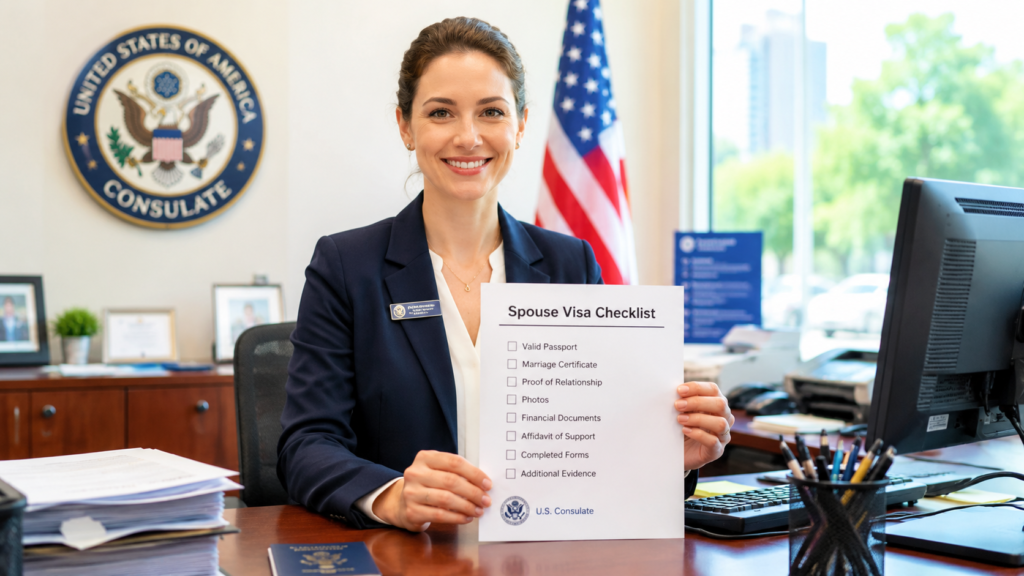
If you are not sure which one applies to you, that is the first question we answer in a consultation. It costs nothing to find out.
ELIGIBILITY
Requirements vary by case. We review your specific situation before preparing anything.
STEP-BY-STEP PROCESS


STEP-BY-STEP PROCESS

We review your family relationship, current immigration status, and goals. You leave knowing exactly what pathway fits your situation.

We provide a complete checklist of every document you need — and explain why each one matters.
Our team helps you complete the required USCIS forms accurately and completely. Errors delay cases — we help you avoid them.
We organize your entire petition package so it is clear, complete, and ready to submit.
We guide you through the submission process, including where to mail or file your package.

We help you understand what comes next — receipt notices, biometrics, interview scheduling, and priority dates.

We help you prepare for USCIS and consular interviews so you walk in feeling ready and confident.
Common Challenges
A marriage petition is not approved simply because you are married. It must clearly show that your marriage is genuine and that every document tells the same story.
Delays can affect immigration status, work authorization, travel plans, and family reunification.
Different dates, addresses, employment history, or relationship timelines across forms often trigger additional scrutiny or Requests for Evidence (RFEs).
A few photos or text messages are rarely enough. USCIS looks for a consistent history of a real shared life together.
Strong evidence can lose its value if it is incomplete, out of order, or difficult for an officer to review.
Missing birth certificates, marriage or divorce records, passports, or civil documents can delay processing.
Every non-English document must include a certified English translation that meets USCIS requirements.
USCIS regularly updates forms and filing requirements. Using the wrong version may result in rejection.
Even simple omissions can cause an application to be rejected or delayed.
Missing tax returns, employment verification, or supporting evidence can delay Affidavit of Support review.
Every Request for Evidence or appointment notice has a deadline. Missing one can seriously affect the case.
The National Visa Center stage is where many cases stall. NVC sends a checklist when anything is missing. Until the checklist is resolved and the file is marked documentarily complete, the consular interview cannot be scheduled. A complete and correctly organized submission avoids this delay entirely.
A date that does not match between the I-130 and the DS-260. A name spelled two different ways. These inconsistencies trigger additional review. We verify consistency across every form and document before submission.
Couples often know each other well but become nervous. Conflicting answers on basic details may raise questions about the marriage.
Previous marriages, children, immigration history, criminal records, long-distance relationships, or significant age differences may require additional explanation and evidence.
International travel while certain applications are pending may affect the case if proper travel authorization has not been obtained.
A strong immigration case is not built on paperwork alone. It is built on consistency, credibility, and careful preparation, so every form, document, and piece of evidence tells one clear story before it is filed.
Reasons
Why Families Choose MY-VIET, INC.
Immigration cases are not paperwork. They are years of waiting, family separations, and fear of one small mistake costing everything. We have sat with that fear for 18 years, across thousands of cases, and we know what it does to a person.
Most of our clients come through referrals. It is something we earn, slowly, over years of showing up for people when it matters most.
Supporting families and professionals through immigration and international education — one case, one family, one future at a time.
Traveled not as a tourist but as a student — of how trust is built, how trade moves, and how cultures make decisions.
FAQs
Frequently Asked Questions
About Spouse and K-1 Fiancé Visas
The K-1 is for engaged couples where the petitioner is a U.S. citizen. Your fiancé(e) enters the U.S. on the K-1, you marry within 90 days, and they apply for a green card. A spouse visa (CR-1 or IR-1) is for couples who are already married. Your spouse goes through consular processing overseas and arrives in the United States as a permanent resident. Which path applies depends on whether you are engaged or already married.
From filing Form I-129F to your fiancé(e) arriving in the U.S., most cases take 8 to 18 months. After arrival and marriage, adjustment of status adds another 12 to 24 months. Total time from first filing to a full green card is typically 2 to 4 years. Timing depends on USCIS processing times, the U.S. consulate in your fiancé(e)’s country, and whether the file is complete.
Most CR-1 and IR-1 cases take 12 to 24 months from filing Form I-130 to your spouse arriving in the United States. This assumes no delays and a complete file submitted correctly from the start.
No. The K-1 is only available to U.S. citizens. If you are a lawful permanent resident, you must marry first and then file Form I-130 to sponsor your spouse. Because green card holder spousal cases fall under the F2A preference category rather than the immediate relative category, there is a wait for a visa number to become available. Current wait times vary by country.
A joint sponsor can fulfill the income requirement. Any U.S. citizen or permanent resident with sufficient income can serve as a joint sponsor by signing Form I-864A alongside your I-864. They do not need to live with you or have any other connection to the case. This is common, accepted, and does not negatively reflect on your petition.
Only if you have also met in person within the two years before filing. Online relationships with no in-person meeting do not meet the K-1 requirement without a narrow exception for documented cultural or religious customs. If you have not yet met in person, that step must come first.
An RFE is a Request for Evidence. USCIS issues one when they need more information or documentation before making a decision. It is not a denial. However, the response must be complete, well-organized, and submitted within the deadline, typically 87 days. A weak or late response can result in denial. We help clients respond to RFEs thoroughly.
Yes. Children of a K-1 visa holder may be eligible for a K-2 visa, which allows them to accompany or follow the K-1 holder to the United States. K-2 visas must be applied for at the same time as the K-1 and require their own documentation. After the K-1 holder marries the U.S. citizen petitioner, K-2 children can also apply for adjustment of status.
Yes, after receiving an Employment Authorization Document (EAD) from USCIS. You file Form I-765 alongside the I-485 adjustment application. Until the EAD arrives, working is not permitted. Once received, your spouse can work for any employer without restriction.
A conditional green card is issued when the marriage is less than two years old at the time of approval. It is fully valid for two years. Within the 90 days before it expires, you and your spouse file Form I-751 together with evidence that your marriage is genuine and ongoing. If approved, USCIS issues a standard 10-year permanent resident card. This process is straightforward for couples in a real marriage.
Administrative processing means the consulate needs additional time or information before making a final decision. It is not a denial. Most cases in administrative processing are eventually approved. The timeline varies. We help clients understand what additional steps may be needed and how to respond if the consulate requests more documents.
Not without an Advance Parole travel document. Leaving the United States without Advance Parole while an adjustment application is pending can be treated as abandonment of the case. You file Form I-131 alongside the I-485 to apply for Advance Parole. We include this in every adjustment of status package we prepare.
OUR APPROACH
Every immigration journey is different. Our role is not simply to prepare forms. It is to understand your situation, identify potential issues early, and help you submit a complete, accurate, and well-organized case.

Every case begins with a conversation, not a form. We take time to understand your goals, your history, your family, and anything that could affect your case.

We walk through your options, eligibility, documents, and timeline. If there is a concern, we say so before filing, not after.
We organize your forms, documents, and certified translations, so your application is complete and consistent, and meets current USCIS standards.

After filing, we help you read USCIS notices, respond to requests for more information, and prepare for interviews or whatever comes next.

Many clients return, for a green card renewal, removal of conditions, citizenship, or a petition for someone else they love. We are grateful to walk with families through every stage.

Immigration is not paperwork. It is one of the biggest decisions of a life. Our goal is simple: help you move forward with clarity, careful preparation, and someone trustworthy beside you.