
The greatest inheritance is rarely measured in dollars.
Ask ten parents what they want for their children, and most will say happiness.
Very few will describe the decisions that quietly create it. Fewer still will mention the years of small, unremarkable choices that eventually shape a child’s confidence, their curiosity, their sense of what is possible for a life. Happiness, it turns out, is rarely handed down directly. It is built, slowly, from ingredients most parents never think to name.
Over nearly twenty years of listening to parents, entrepreneurs, and families across many countries, one observation keeps returning. When people speak about legacy, they almost always begin with money. When they speak about what actually mattered, years later, they almost never do.
This essay is about that gap, and what tends to fill it once the conversation goes deeper.

A quiet sacrifice
A couple ran a small business for over a decade. Long hours. Little time for anything beyond the store and their two children. They were not wealthy. They saved carefully, and much of what they saved went toward something they rarely discussed openly. The possibility of a different kind of education for their children. One they themselves never had access to.
Neighbors sometimes asked why they worked so hard without taking vacations, without upgrading their home, without the visible signs of success their income might have allowed. They rarely explained. The reasons were not for public conversation.
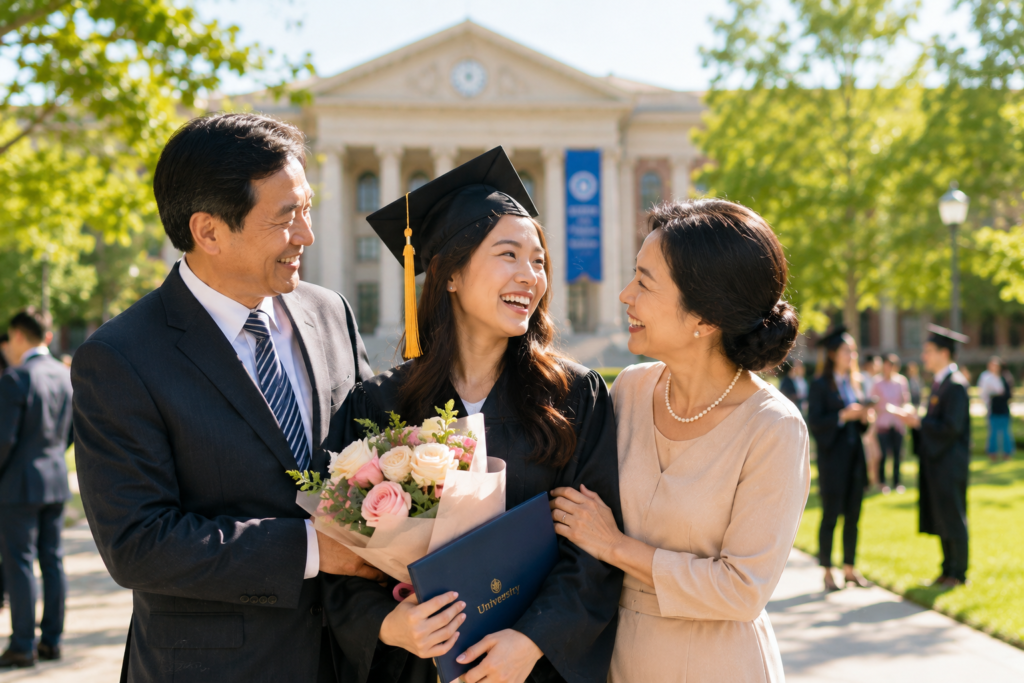
Years later, their daughter, then finishing a degree abroad, described her parents’ sacrifice simply. She said she never once felt poor growing up. She felt, instead, that her parents were quietly building something for her that she would not fully understand until much later.
She was right. It was not the store they were building. It was her.
This is a story we have heard in different forms, across many families, many countries, many languages. The details change. The shape of the sacrifice changes. What stays the same is the quiet, determined act of building something that will outlast the building itself.
What legacy actually means
Parents naturally focus on providing. Food, safety, a stable home, enough savings to weather a difficult year. These instincts are sound. No family survives without them.
But providing and building are not quite the same thing. Providing meets today’s needs. Building creates tomorrow’s possibilities. Somewhere between these two instincts, a quieter kind of legacy takes shape. One rarely discussed at the dinner table. Rarely written into a will.
Children remember opportunities far more clearly than they remember possessions. They remember the summer they were exposed to a new idea, the teacher who noticed something in them, the moment a parent trusted them with a real decision instead of making it for them. They remember these things longer, and more vividly, than almost anything that arrived wrapped or invoiced.
The strongest legacy is not what parents leave behind after their lives are over. It is what they quietly build ahead, while their lives are still very much in progress.
Three invisible gifts
Across many years and many families, the deeper legacy tends to take one of three forms, repeated with remarkable consistency regardless of income, country, or profession.
The first is how children learn to think. Their mindset, their character, the internal habits that shape how they approach a problem long after their parents are no longer in the room to guide them.
The second is what opportunities they can actually reach. Their education, their exposure to the wider world, in some cases their citizenship, the doors that stand open to them simply because of decisions made years before they were old enough to make such decisions themselves.
The third is how they choose to live once those doors are open. Their values, their integrity, their resilience when circumstances are difficult, the quiet responsibility they carry toward the people around them.
Money can support all three of these gifts. It cannot replace any of them.
It helps to hold these three as a simple working model rather than a rigid checklist. Mindset shapes how a child approaches a difficult problem. Opportunity determines how many rooms are open to them once they choose to walk toward one. Values determine what they do once they are standing inside that room. Whether they treat the people around them with fairness. Whether success, once achieved, changes who they are or confirms who they already were.
A family strong in only one or two of these areas often produces children who are capable but unsettled, or comfortable but underprepared for what real difficulty feels like. The families who seem, from the outside, to have gotten this right rarely focused on one gift at the expense of the others. They simply kept returning attention to all three, year after year, without ever declaring the work finished.
That returning of attention, quiet and consistent, is the work itself.
Education as expansion, not credential
Education, understood well, is rarely only about degrees.
It is about curiosity kept alive long after formal schooling ends. It is about critical thinking, the habit of asking a second question before accepting the first answer. It is about language, which shapes not only how we communicate but how a mind organizes its own thinking. It is about confidence built through genuine exposure to unfamiliar ideas and unfamiliar people, rather than confidence borrowed from comfort alone.
A strong education expands what a person believes is possible for their own life. This expansion often matters more than any single credential. A child who learns early that ideas can come from anywhere, and that unfamiliar situations are worth approaching with curiosity rather than anxiety, carries that way of moving through the world into every decade that follows.
We have watched this play out, in family after family, over many years. The child who entered an unfamiliar environment early, even reluctantly, and found their footing, tends to carry that experience as proof of something important about themselves. Not proof that the new environment was better. Proof that they could handle it. That confidence, once built, compounds in ways that are very difficult to manufacture later.
Character arrives before assets do
Children inherit habits long before they inherit anything material.
They watch how their parents solve problems under pressure. They notice whether promises, once made, are kept. They observe how their parents treat people who cannot offer anything in return, and they absorb, often without either party realizing it, how uncertainty is handled in a household. Calmly or anxiously. Patiently or impulsively. With grace or with grievance.
Children rarely become who we tell them to be. They become what they quietly watch every day.
This is, perhaps, the least controllable and most powerful form of legacy available to any parent. It requires no estate planning, no financial advisor, no legal structure. It requires only consistency, repeated over years, in view of a child who is paying closer attention than anyone realizes.
Character, built this way, compounds. A child raised watching integrity in practice tends to practice it themselves, and often passes the same habit to their own children, long after the specific lessons that formed it have been forgotten. The lesson disappears. The habit remains. And the habit, carried forward by a child who does not even remember learning it, continues to shape lives long after the parent who modeled it is gone.
This is also why character tends to survive circumstances that money does not. A financial inheritance can be mismanaged, lost to a poor decision, or divided until it means very little to anyone. A habit of integrity, once genuinely absorbed, tends to travel with a person through every version of their life. Prosperous or difficult. Familiar or foreign. The account balance fluctuates. The character holds.
Parents who focus their energy here are building something considerably harder to lose.
Citizenship as belonging, not status
Citizenship deserves a careful word, because it is easy to misunderstand as a technical matter rather than what it actually represents for a family.
At its best, citizenship offers belonging. Participation in a community and its institutions. A degree of long-term security that allows a family to plan in decades rather than years. Freedom to pursue education, work, and opportunity without the quiet uncertainty that comes from living permanently at the margins of a system.
We have sat with many families at the point of this decision. What strikes us, again and again, is that the families who approach citizenship most clearly are not the ones focused on the document. They are the ones who already know what they are building and see the document as one piece of something larger. A piece of stability. A piece of belonging. One gift among three, not a replacement for the other two.
Families who understand this tend to hold citizenship with a certain lightness. Grateful for what it enables, without mistaking it for the whole of what they are building.
What business owners actually build
Entrepreneurs often believe they are building a company. In our experience, watching many of them over many years, they are usually building something else at the same time, whether they intend to or not.
They are building an example.
Children of business owners rarely remember the specific deals their parents closed. They rarely know the numbers. What they remember is how their parents handled a difficult year. How they treated employees when a hard decision had to be made. How they responded when a plan failed and needed to be rebuilt from the beginning, without the certainty that rebuilding would work.
Leadership, more than success itself, tends to be what a child absorbs from watching a parent build something from nothing. The losses, handled with honesty. The uncertainty, carried without panic. The recovery, attempted without guarantee.
The way parents make decisions, especially difficult ones, often becomes the family’s most durable and least visible inheritance. More durable than the company. More visible, in the end, than the success.
Why the urgent crowds out the important
None of this is a criticism of parents who focus primarily on today’s needs. School fees, mortgages, the ordinary weight of running a household, these demand attention because they arrive with deadlines attached. Legacy, by contrast, rarely announces a due date.
This is precisely why it gets built, when it gets built at all, through many small decisions repeated quietly over years, rather than through one extraordinary act. A conversation about values, held once a year rather than never. A decision to expose a child to something unfamiliar, even when the familiar option was easier and less disruptive. A habit of including children, as they grow older, in the reasoning behind family decisions rather than only the outcomes.
None of these decisions feels significant the moment they are made. Their significance becomes visible only in accumulation. Usually a decade or more later. When a grown child handles something difficult with a steadiness they never had to be taught, because they watched it modeled long before they knew they were watching.
Where immigration fits into this legacy
Immigration, understood through this lens, is simply one instrument among several that families sometimes use to expand the second gift. The opportunities their children can actually reach.
A family that relocates for education is not pursuing immigration as an end in itself. They are pursuing a wider set of doors for a child who has not yet had the chance to walk through any of them. A parent pursuing eventual citizenship is not chasing a document. They are pursuing the stability and belonging that document tends to represent for the family that holds it.
At MY-VIET, this is what we have come to understand most deeply after nearly two decades in this work. The families who navigate this process best are not the ones most focused on the paperwork. They are the ones who already know what they are building and are simply looking for the right tools to build it. Immigration, for these families, is one thoughtful instrument among many. Useful precisely because it can widen a child’s access to education, opportunity, and long-term security, alongside the character and values a family has already been building at home, year after year, long before any paperwork existed.
The paperwork serves the legacy. It does not replace it.

A closing reflection
A family’s greatest inheritance is not measured by what remains after life ends. It is measured by the opportunities created while life continues, and by the character quietly absorbed by the people watching it happen.
What moves us most, after nearly two decades in this work, is not the families who arrive with the clearest plan. It is the families who arrive with the clearest sense of what they are trying to build. They do not always know the right visa category. They do not always know the right timeline. But they know their children. They know what they hope for them. And they know, with a quiet certainty that no document can give them, that this moment, this decision, this willingness to move before everything is perfect, is part of something larger than a form to be filed.
Those are the families we have been most honored to walk beside.
For nearly two decades, MY-VIET has had the privilege of helping families begin new chapters in the United States. Over the years, we have learned that the most meaningful decisions are rarely about paperwork alone. They are about creating opportunities, protecting values, and preparing future generations for lives filled with greater choices.
The greatest legacy parents leave behind is rarely something their children receive.
It is something their children become.