
Markets change. Governments change.
Yet generation after generation, ambitious people continue building their future in America. Why?
Throughout history, ambitious people have rarely asked where everything is perfect.
They ask a narrower, more practical question: where can I build? Where will my ideas meet the right customers, the right capital, the right collaborators, at the right moment? No country has ever answered this question perfectly. But for well over a century, one country has answered it consistently enough to keep drawing builders across oceans, generation after generation.
Over nearly twenty years of working alongside entrepreneurs, researchers, investors, and families making this exact calculation, one observation has held steady across every industry and every background. People rarely move in search of certainty. They move in search of room.
This essay is an attempt to understand that room. Not through politics. Through the quieter architecture of institutions, markets, and ideas that has made it possible for so long.
A researcher’s choice
A researcher once had two offers. One at a university in her home country. One in the United States. The salaries were comparable. The subject matter was identical.
What differed was the ecosystem surrounding each position. In one, her research would proceed carefully, within a well-established structure. In the other, she would have access to a wider network of collaborators, faster paths to funding for unproven ideas, and closer proximity to the companies capable of eventually building on her work.
She did not choose based on comfort. She chose based on velocity. How quickly an idea could move from question to experiment to real-world application.
Years later, she described the decision simply. She had not been searching for the best country. She had been searching for the shortest distance between a good idea and the resources needed to test it.
This is, in some form, the calculation most builders are making. They are not asking which country is the most beautiful, the most stable, or the most comfortable to grow old in. They are asking something more specific. Where will my work find its fullest expression? Where will the people around me push me further than I could push myself?
The answer to that question has pointed, again and again, in the same direction.
What builders are actually evaluating
Entrepreneurs and researchers rarely evaluate a single factor when deciding where to build. They evaluate an ecosystem, the way an experienced investor evaluates a portfolio rather than a single stock.
They look for markets large enough to reward a good idea at scale, and open enough that a newcomer can compete without decades of entrenched advantage standing in the way. In many parts of the world, who you know matters more than what you know. In America, that is sometimes still true. But not nearly as often, and not nearly as completely.
They look for capital willing to fund ideas before those ideas have proven themselves, because a market that only funds certainty rarely funds anything genuinely new. The most important inventions of the past century were, at the moment they were funded, considered impractical by the majority of sensible people. What changed was not the idea. It was the presence of investors willing to bet on the minority view.
They look for institutions predictable enough that a ten-year plan is worth making in the first place. No one builds seriously in an environment where the rules might shift beneath them without warning. Legal certainty, property rights, enforceable contracts, these are not exciting subjects. They are the invisible foundation that makes every exciting thing possible.
They look for permission to fail and begin again. This one deserves special attention, because it is often the thing that surprises newcomers most. Very few of the world’s most consequential companies succeeded on their first attempt. Amazon started as a bookstore. Apple nearly went bankrupt. What distinguished their founders was not the absence of failure. It was the presence of a system tolerant enough to let them try a second time, and a third, without treating an early failure as a permanent verdict on their judgment or their character.
America’s particular strength has never been the absence of these conditions elsewhere. Many countries offer some of them, and several offer them exceptionally well. America’s strength has been the unusual degree to which it has combined all of them, at scale, over a sustained period of time, inside a legal system builders have generally been able to trust. This combination is rarer than it appears. It is also harder to replicate than most countries have found.
Universities as ecosystems, not degrees
American universities attract global talent for reasons that go well beyond the credential itself.
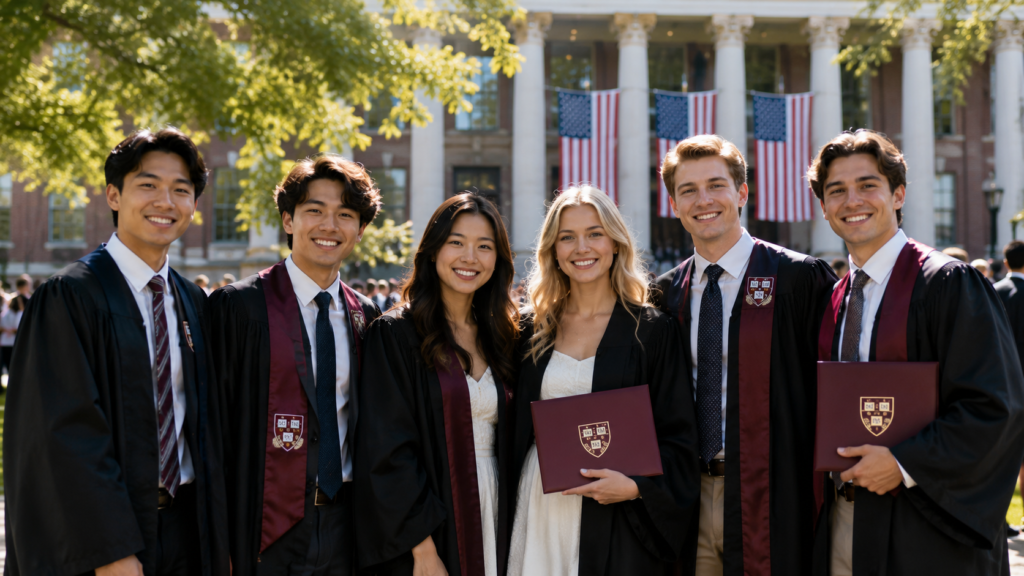
A degree from a strong university is a single document. What surrounds that document, in the strongest American institutions, is a dense web of research funding, industry partnerships, and alumni networks spanning nearly every major economy in the world. A student does not simply learn inside a classroom. They learn beside researchers actively building the next decade’s technology. Beside classmates who will, within a few years, be founders, investors, and executives themselves. Beside professors who consult for the companies that will eventually hire the students sitting in front of them.
This is what makes a university an ecosystem rather than a transaction. The learning matters. The proximity to people building something new matters just as much. Often more.
Innovation begins where different experiences meet. A campus that gathers students, researchers, and entrepreneurs from dozens of countries creates exactly this kind of meeting point, repeated daily, for four years or more. Ideas that would never have found each other in isolation become, inside these environments, the foundation for companies, research programs, and collaborations that outlast any single person’s time on campus.
There is something else worth naming, something rarely discussed in brochures. The experience of being surrounded by high ambition, normalized ambition, shapes a person’s sense of what is possible. A young person who grows up watching classmates start companies, raise funding, and fail and start again develops a relationship with risk that is simply different from someone who never witnessed any of it. America’s universities have been, for generations, one of the primary places in the world where this kind of normalization happens. The credential opens doors. The environment changes what a person believes those doors might lead to.
Capital that moves before certainty exists
Investment, at its core, follows trust rather than comfort.
Capital moves toward institutions and markets where property rights are respected, contracts are enforced, and courts behave predictably enough that a long-term bet is worth placing. Remove any one of these, and capital becomes cautious. Remove more than one, and it leaves.
America has built, over a long period, a financial system unusually willing to fund ideas before they are proven. Venture capital, in particular, developed there earlier and at greater scale than almost anywhere else, precisely because enough investors were willing to accept a high failure rate across many bets, trusting that a small number of successes would justify the entire pattern.
This tolerance for early-stage risk is not a small detail. It is one of the more decisive reasons ambitious builders continue arriving. A founder with an unproven idea and no track record can, in America, still find capital willing to take the first real risk on them. Not easily. Not always. But the infrastructure for it exists in a way that, in many markets, it simply does not.
In many countries, this kind of capital is scarcer. Not because the ideas are weaker. Not because the founders are less capable. But because the institutions supporting early risk are less developed, and the culture surrounding failure is less forgiving. A founder who fails in some environments carries that failure for a decade. In America, it is often worn, quietly, as a credential.
Markets evolve. Capital adapts to wherever trust and opportunity intersect most reliably. For a long stretch of modern history, that intersection has often pointed toward the United States. Whether that continues depends, in part, on whether the institutions that created the intersection continue to hold.
Where talent gathers, more talent follows
Talented people rarely build in isolation. They build near other talented people, because proximity accelerates learning in ways that distance cannot replicate.
Innovation clusters, the kind that produce entire industries rather than single companies, tend to emerge where universities, capital, established businesses, and ambitious newcomers occupy the same geography. Once such a cluster reaches a certain size, it becomes self-reinforcing. Great engineers want to work near other great engineers. Investors want to be close to the founders they might eventually fund. Founders want easy access to both. And everyone wants to be near the customers, the talent, and the culture that makes rapid iteration possible.
America has produced several of these clusters. Technology in the Bay Area and Seattle. Biotechnology in Boston and San Diego. Finance in New York. Entertainment in Los Angeles. Each one is a magnet strong enough to keep pulling talent from around the world, long after the original advantages that created the cluster have been matched or exceeded elsewhere.
The interesting thing about a mature cluster is that it continues to attract talent even when the economics might seem to favor leaving. Rents are high. Competition is fierce. The founders who arrived a decade ago have already captured much of the obvious opportunity. And yet people keep coming. They come because the density of people, ideas, and capital in a mature cluster still offers something that a cheaper, quieter alternative cannot: the chance to collide, daily, with the people who are building what comes next.
Great ecosystems attract great people. Great people build great companies. Great companies attract more great people. This cycle, once established, is surprisingly durable. It is also, perhaps, the simplest explanation for why the pattern continues even as the world flattens and alternatives multiply.
Freedom as optionality
Freedom, in this context, is worth discussing carefully and without the weight of politics.
What builders consistently describe valuing is not an abstract freedom, but a practical one. The freedom to start a company without years of prior permission. The freedom to fail and legally begin again. The freedom to reinvent a career entirely in a new industry without being permanently defined by the first one they chose. Many entrepreneurs, when asked directly, say they value this kind of optionality more than they value certainty itself.
This makes sense, when you think about it. Certainty is, for a builder, almost beside the point. What a builder needs is not the assurance that nothing will go wrong. It is the assurance that when things go wrong, and they will, the system will allow them to recover, regroup, and try again with whatever they learned from the first attempt.
Optionality is what allows a builder to change direction when the market changes, without the change itself becoming an existential threat. A system that preserves this kind of flexibility, even imperfectly, tends to keep attracting people who value the ability to adapt over the promise of a fixed and guaranteed outcome. Builders, almost by definition, are people who believe the future is not yet written. What they need is a place that believes the same thing.
There is something quietly psychological about this. A person who has spent years operating in an environment where failure carries lasting stigma develops a different relationship with risk than a person who grew up watching failure treated as a natural part of the process. These are not small differences in attitude. They are differences in how a person moves through the world, what they attempt, what they avoid, how long they persist when the first version of something doesn’t work. The system shapes the builder as much as the builder shapes what they build.

A note of respect for what others offer
None of this suggests America is without serious weaknesses, or that other nations lack comparable strengths.
Every country carries its own combination of advantages, shaped by its own history, culture, and institutions. Germany’s manufacturing precision. Japan’s long-term industrial discipline. Singapore’s efficiency and rule of law. Canada’s stability and openness. The Nordic countries’ investment in human capital. Each of these represents a genuine and durable strength that many parts of the world have looked to and learned from.
Some countries excel at social stability in ways America has not. Some offer public infrastructure of a quality that American cities would envy. Some have built educational systems that produce consistent, high-quality outcomes for nearly every student, not only those fortunate enough to attend elite institutions.
America’s particular contribution has been its unusual ability to bring people, ideas, capital, universities, and businesses together at extraordinary scale, and to keep doing so across many decades and many waves of newcomers from every part of the world. This is not a claim of superiority. It is an observation about a specific kind of ecosystem, and why it continues to draw a specific kind of person: the person who has an idea they believe in, and is looking for the place most likely to let them test it at full speed.
Where immigration fits into this picture
Immigration, understood this way, is not the destination for the people this essay describes. It is one pathway through which they participate in an ecosystem they have already decided is worth joining.
The founder relocating a company. The researcher accepting a university position. The family investing in their children’s education. All are pursuing something larger than a document. They have made a judgment about where their energy, their ideas, and their children’s futures are most likely to find full expression. The visa is simply the mechanism that makes the judgment operational.
Business immigration, in this light, is the legal bridge through which entrepreneurs bring their ambition into contact with American markets and capital. Family immigration is often the mechanism through which parents position their children near the same universities and industries that first drew the parents themselves. In both cases, the paperwork follows the decision. It does not precede it.
Contribution is the goal. Immigration is the bridge that makes contribution possible. The builders who arrive are not arriving to take. They are arriving to add. They carry ideas, disciplines, perspectives, and experiences that the ecosystem absorbs and transforms into something neither the newcomer nor the place could have produced alone. This exchange is not new. It is, in many ways, the mechanism through which the ecosystem has renewed itself across every generation of newcomers.
A closing reflection
The strongest economies are often built by people willing to imagine lives beyond the familiar. And by institutions patient enough to let those people try, fail, and try again.
For nearly two decades, MY-VIET has had the privilege of helping families, entrepreneurs, professionals, and students begin new chapters in the United States. Over the years, we have learned that successful transitions rarely begin with paperwork alone. They begin with understanding where opportunity exists, preparing thoughtfully, and building with purpose and patience.
What draws the world’s builders to America has never been a guarantee. It has been a combination of room, resources, and resilience, a system that has remained, across many generations, more willing than most to let people try.
The countries that attract the world’s builders rarely promise certainty.
They simply offer room to build.